
AI search rewards trusted brands, not just optimized pages. Learn how to audit your AI visibility and build the entity signals Google’s AI recognizes.
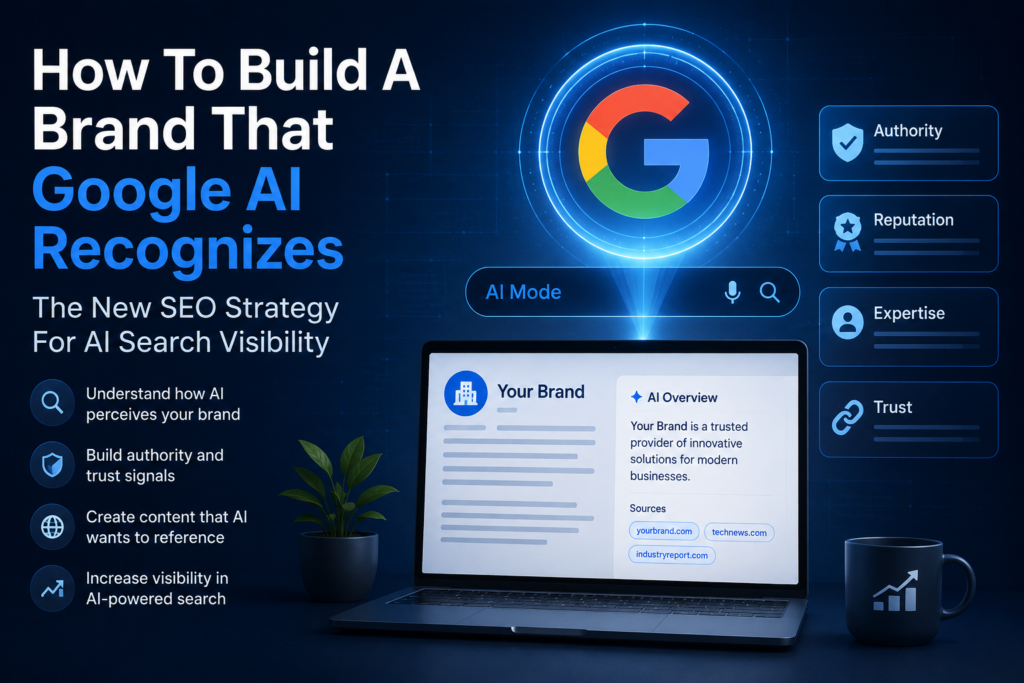
Introduction: SEO Is Shifting From Ranking Pages to Building Recognized Brands
For two decades, SEO followed a simple formula: find keywords, publish optimized content, build backlinks, and climb the rankings. Companies poured budget into landing pages targeting exact searches like “best software development company” or “AI automation agency.” The goal was straightforward — rank high, capture organic traffic.
AI-powered search has changed that foundation.
Search engines now focus less on matching exact keywords and more on understanding entities, relationships, reputation, expertise, and trust. When Google’s AI experiences (like AI Overviews) handle a query, they try to understand the full context behind it:
- Who is providing this information?
- Is this company a recognized expert?
- Does this brand have real-world credibility?
- Are other trusted sources mentioning it?
- Has this organization actually solved this specific problem?
The question is no longer “Which page contains the best answer?” It is becoming “Which company, expert, or source can I trust to answer this?”
This is one of the biggest shifts in SEO history. A site with thousands of articles can stay invisible if AI can’t understand the brand behind them. Meanwhile, a smaller company with a clear identity, consistent signals, expert content, and external recognition can show up in AI answers — because the system understands its authority.
The future of SEO isn’t producing more content. It’s building a brand AI systems can recognize, understand, and trust.
1. Audit How Google AI Understands Your Brand, Before Creating More Content
The most common mistake today is producing more content without first understanding how search engines currently perceive your brand.
Many businesses assume 50 new blog posts will automatically lift visibility. But content alone doesn’t create authority. Before investing months in production, run an AI visibility audit to answer one foundational question:
“What does Google actually know about my company?”
The goal is to learn whether search engines recognize your business as:
- A legitimate company
- A specialist in a specific field
- A trusted source of information
- A brand associated with specific topics and solutions
Without this foundation, even excellent content can struggle to perform.
What Is an AI Visibility Audit?
An AI visibility audit analyzes how your company appears across search engines, AI platforms, and the wider web.
A traditional SEO audit focuses on technical issues, keywords, backlinks, page speed, and rankings. An AI visibility audit goes deeper, into:
- Brand recognition and entity understanding
- Expertise (E-E-A-T) signals
- Reputation and reviews
- Mentions across the web
- AI search recommendations
The point isn’t only where you rank. It’s whether AI systems know who you are.
2. Step One: Search Your Own Brand Name
Start with the simplest test. Search your company name on Google, then analyze what appears. Run variations:
- Your company name
- Company name + industry
- Company name + reviews
- Company name + competitors
- Company name + alternatives
Then judge the results from Google’s perspective.
Does Google Understand Who You Are?
When someone searches your brand, does Google immediately understand what you do, your industry, your customers, and what makes you different?
A strong result paints a clear picture:
“Company X is an AI development agency helping SaaS startups build automation solutions.”
A weak one is vague:
“Company X is a website with some articles about software.”
That difference is entity recognition.
Evaluate These Signals
1. Brand description. Is Google’s description accurate? If it’s wrong, outdated, or generic, Google lacks reliable information. Your website, social profiles, directories, and mentions should all communicate the same positioning.
2. Knowledge & entity signals. Search engines connect information from many sources — websites, social profiles, news, directories, reviews, articles, interviews. If your company only exists on your own site, Google has limited evidence. Strong brands are confirmed by multiple independent sources.
3. Third-party mentions. One of the strongest authority indicators is other sites mentioning you: industry publications, partner sites, customer case studies, podcast interviews, conference pages, expert articles. A company saying “we are experts” is far weaker than a trusted source saying “this company is recognized for solving this problem.” AI relies heavily on this external validation.
3. Step Two: Test AI Search Prompts
Keyword research alone is no longer enough, because search behavior has changed. Instead of short keywords, people increasingly ask full questions.
- Traditional search: “best React development agency”
- AI search behavior: “Which companies provide reliable React development services for startups in Europe?”
They look similar but require completely different understanding. The first matches keywords. The second forces AI to weigh reputation, geographic relevance, industry experience, customer trust, and technical expertise — and then decide which companies deserve to be recommended.
Build Your AI Prompt Database
Create 50–100 prompts that reflect what your customers actually ask, across categories:
- Commercial: Who are the best companies for AI automation? Which agencies build SaaS applications?
- Comparison: Agency vs. hiring developers internally? Best alternatives to large consulting firms?
- Educational: How much does custom software development cost? How can companies implement AI automation?
- Industry: What are the biggest challenges for SaaS startups in 2026? How are companies using AI to improve operations?
Measure Your AI Visibility
For every prompt, track four things:
- Are you mentioned? If not, note who appears instead.
- Which competitors are visible? Study their content strategy, mentions, reputation, and positioning — they reveal the signals Google values.
- What sources does AI cite? News, reviews, industry reports, company profiles, expert interviews? These show where authority is being built.
- What information is missing? Often you’re invisible simply because the information doesn’t exist online — your specializations, the customers you serve, your technical expertise, your results, your differentiators. Your content strategy should fill those gaps.
4. Why the Audit Comes Before the Content
Many companies do SEO backwards. They start with “Let’s publish more articles.” The better starting point is “Let’s understand what Google needs to know about us.”
The audit reveals missing authority signals, content opportunities, competitor weaknesses, and positioning problems. Only then should you build a content strategy — one designed not to publish more information, but to publish information that strengthens how AI systems understand your brand.
5. The New SEO Mindset
The companies that win in AI search won’t be the ones producing the most content. They’ll be the ones with the strongest digital identity.
AI systems need confidence before recommending a brand. That confidence comes from:
- Clear positioning
- Consistent information everywhere you appear
- Expert content
- External recognition
- Customer proof
- Industry authority
The first step toward AI visibility is simple: understand how Google sees you today — then build the signals it needs to recognize you tomorrow.